
| AI OVERVIEW |
|---|
| A Third Party Administrator (TPA) is an IRDAI-licensed company that an insurer appoints to handle health insurance services on its behalf, mainly claims processing (cashless pre-authorisations and reimbursements), issuing health cards, managing network hospital relationships, and running helplines. TPAs are governed by IRDAI’s TPA (Health Services) regulations and are paid by the insurer, not by you; you can’t be charged for TPA services. The final decision on a claim, including any rejection, rests with the insurer. Some insurers use TPAs, while others handle claims in-house. For policyholders, a TPA is the operational link between you, the hospital and the insurer; knowing who your TPA is, keeping its helpline and your e-card handy, and understanding the escalation path can make claims much smoother. |
The name on your health card that isn’t your insurer
You bought your policy from Insurer X. You’ve paid Insurer X every year. Then you’re admitted to hospital, the insurance desk takes your card, and says, “We’ll send this to your TPA.”
“My what?”
It’s one of the most confusing moments in Indian health insurance. The company approving your cashless request, asking for documents, or calling about your claim may not be your insurer at all. It’s a Third Party Administrator, a licensed middleman working behind the scenes.
That’s not a problem. But not knowing it is. People have missed calls from TPAs thinking they were spam, sent documents to the wrong address, or escalated complaints to the wrong company. This guide explains what a TPA does, who it answers to, what it can and can’t decide, and how to work with it smoothly.
What is a TPA?
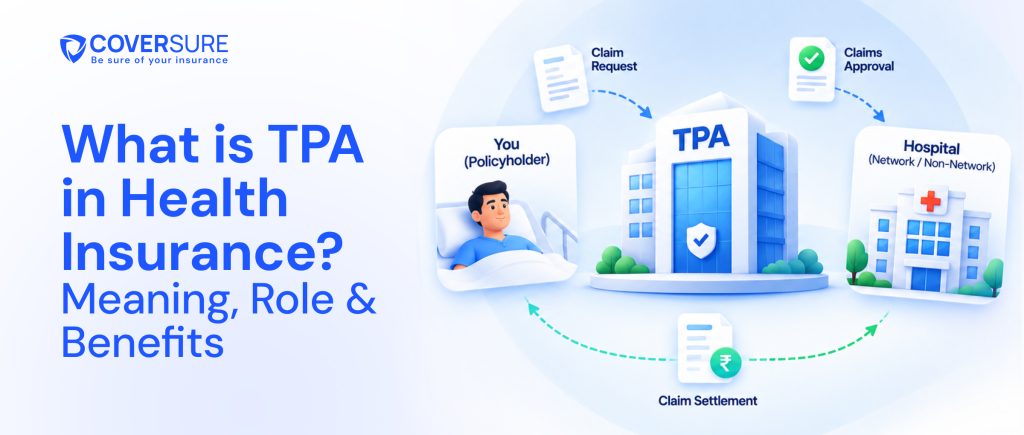
A TPA is an IRDAI-licensed company appointed by a health insurer to provide health services on its behalf. It works under a service agreement with the insurer and is regulated under IRDAI’s Third Party Administrators (Health Services) regulations.
Key points:
- Licensed by IRDAI, with defined duties and a code of conduct
- Paid by the insurer, not by you
- Acts on the insurer’s behalf; the insurer remains responsible to you
- Final claim decisions, including rejections, rest with the insurer
What does a TPA do?
| Function | What it involves |
|---|---|
| Health cards/e-cards | Issues ID cards used for cashless admissions |
| Cashless pre-authorisation | Receives hospital requests, reviews documents, approves amounts on the insurer’s behalf |
| Enhancements and discharge | Processes additional approvals and final discharge authorisation |
| Reimbursement processing | Scrutinises bills and documents, calculates admissible amounts |
| Network management | Empanels hospitals, negotiates package rates, monitors quality |
| Helpline and support | 24×7 assistance for admissions and claim queries |
| Data and records | Maintains claims data and reports to the insurer |
| Wellness and other services | Some TPAs support health check-ups or wellness programmes, as permitted |
What a TPA can’t do
- Charge you for its services
- Sell insurance policies or act as your agent
- Override the insurer’s final decision on your claim
- Ask for irrelevant documents or delay without reason
Why TPAs exist
- Scale: insurers handle millions of claims; TPAs bring processing capacity and hospital networks
- Specialisation: medical teams for claim scrutiny and cashless approvals
- Reach: wider hospital coordination across cities
As India’s health insurance market grows (secondary reports on the IRDAI Annual Report 2024-25 cite around 3.26 crore health claims processed in FY25), efficient claim administration matters more than ever. (Please verify the figure on irdai.gov.in.)
TPA vs in-house claims
| TPA-based claims | In-house claims | |
|---|---|---|
| Who processes | Licensed TPA on insurer’s behalf | Insurer’s own claims team |
| Who decides | Insurer (final authority) | Insurer |
| Your contact | TPA helpline and desk | Insurer helpline |
| Your rights | Same IRDAI timelines and protections | Same |
Neither is automatically better; service quality varies. Check the insurer’s complaint data and your city’s hospital experience. See ICR vs CSR vs complaint volume.
How does a claim flow through a TPA?
Cashless
- You’re admitted to a network hospital and show your e-card.
- The hospital sends a pre-authorisation request to the TPA.
- The TPA reviews it and communicates approval (IRDAI’s target: decision within 1 hour).
- Enhancements are requested as treatment progresses.
- At discharge, the TPA issues final authorisation (IRDAI’s target: within 3 hours).
Reimbursement
- You pay the hospital and submit documents to the TPA (or insurer, as per policy).
- The TPA scrutinises and calculates the admissible amount.
- The insurer approves and pays (settlement within 30 days of the last document, or 45 days if investigated).
| Deep dives: cashless claims and reimbursement claims. |
Case study: a TPA claim, decoded
Hypothetical.
Rekha is admitted for a planned hernia surgery. Her policy is serviced by a TPA.
| Stage | What happened | Time |
|---|---|---|
| Intimation | Rekha informed the TPA helpline 3 days before admission | Day -3 |
| Pre-auth request | Hospital sent an estimate of ₹1,20,000 | Day 0, 10:00 |
| Initial approval | TPA approved ₹1,00,000 and asked for a previous scan report | Day 0, 10:50 |
| Enhancement | Hospital requested ₹30,000 more after surgery | Day 1 |
| Final bill | ₹1,32,000, including ₹6,000 non-payables | Day 2 |
| Discharge authorisation | Approved ₹1,26,000 | Day 2, within 2.5 hours |
| Rekha paid | ₹6,000 (non-payables) |
What helped: early intimation, a complete document set, and a quick response to the TPA’s query.
Tips for working with your TPA
- Know your TPA’s name and helpline (on your e-card or policy schedule).
- Save the e-card on your phone and share it with family.
- Intimate early, especially for planned admissions.
- Answer queries fast and keep copies of everything submitted.
- Escalate the right way: TPA helpline, then insurer’s grievance officer, then IRDAI’s grievance channels, then the Insurance Ombudsman.
- Don’t pay anyone for claim approval. TPA services are free to you.
Where CoverSure helps
- Keep policy numbers, e-cards and TPA details for every family member in one place: Insurance Portfolio
- Know your claim-time clauses before admission: Know Your Policy
- In the moment: Insurance SOS helps with emergency support and hospital details
- Claim stuck with the TPA? Advisory can help you navigate the escalation path
- Make sure your policy is strong before you ever need a TPA: Policy Health Check
| Also useful: How to claim health insurance and Claim chaos to claim readiness.
Your TPA is the backstage crew. Know their number before the show. Download the CoverSure app and keep every e-card handy. TPA not responding and the hospital’s asking for a deposit? Book a call with us. We’ll help you push it along. |
FAQs
- What is a TPA in health insurance? An IRDAI-licensed company that processes claims and provides health services on an insurer’s behalf.
- Do I pay the TPA? No. TPAs are paid by the insurer.
- Who decides my claim, the TPA or the insurer? The insurer has the final say, even if the TPA processes the claim.
- Can I choose my TPA? Usually, the insurer appoints the TPA. Check your policy schedule or e-card.
- What if the TPA rejects my cashless request? You can pay and claim reimbursement, and escalate to the insurer’s grievance officer if needed.
- “Alexa, what does a TPA do in health insurance?” A TPA processes your cashless and reimbursement claims for your insurer and manages hospital networks. You don’t pay for it.
Know who’s who in your insurance: follow the CoverSure newsletter.