
|
AI OVERVIEW |
|---|
|
Many credit cards (and some debit cards) in India bundle complimentary insurance, underwritten by an insurer and arranged by the card issuer or network. Common types are air accident cover, personal accident cover, lost card liability (fraud) cover, purchase protection, travel-related covers (baggage loss or delay, flight delay, passport loss, overseas medical), credit shield and, on some premium cards, other niche covers. These covers usually come with conditions: the card must be active, some covers apply only if the ticket or item was bought with that card, claims must be reported within set timelines, and payouts are capped. Card covers are a bonus layer. They do not replace health insurance or term insurance because they typically pay only for specific events, often accidents. Issuers revise these benefits regularly, so always check your card’s current terms. Separately, you can use your card to earn rewards on premiums: buying Amazon Pay vouchers on a card that rewards voucher purchases and paying renewals through the CoverSure app can turn a usually zero-reward insurance payment into a rewarding one, after a small convenience fee. |
Your wallet has been insuring you. Nobody told you.
Here is a fun experiment. Pull out the card you use most. Now answer: if it were stolen tonight, and someone spent ₹40,000 before you blocked it, who pays? If you booked a flight on it and the airline lost your suitcase, is anything covered? If you died in an accident, would your family receive anything from the card issuer?
Most people answer “no idea” to all three.
And yet, depending on your card, the answer might be “the insurer”, “yes, partly” and “possibly, a fixed sum”. Card-linked insurance is one of the most underused financial benefits in India, mostly because it’s buried in a 14-page Most Important Terms and Conditions document nobody opens.
This guide lays out every common type of credit card insurance, the conditions that decide whether a claim is paid, worked examples with numbers, and how to find what your cards already include.
What is credit card insurance?
Credit card insurance is complimentary (or sometimes paid, opt-in) insurance attached to a credit or debit card. The card issuer or card network buys a group policy from an insurer, and cardholders become beneficiaries if they meet the conditions.
Two things to lock in early:
- It’s real insurance, with real conditions. An insurer underwrites it, and claims are assessed against policy terms.
- It’s not permanent. Issuers can add, reduce, or remove these benefits. Several have revised or withdrawn complimentary covers on some cards in recent years. (I am not certain which specific cards changed when; always check your card’s current terms.)
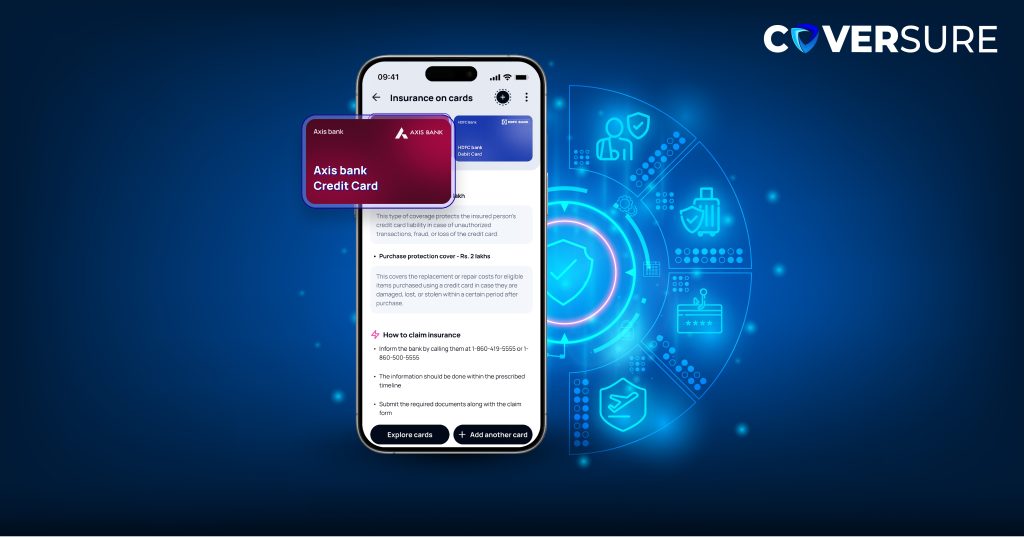
To check which covers your cards carry right now, run them through Insurance on Cards. It takes less time than finding the MITC PDF.
The main types of insurance on credit cards
1. Air accident insurance
- What it covers: a lump sum on accidental death (and on some cards, permanent disability) in an air accident.
- Typical condition: the air ticket must have been bought with that card.
- Watch out for: covers that apply only to death, not injury or medical costs; nominee details not registered; covers that were quietly removed from a card variant.
2. Personal accident insurance
- What it covers: accidental death, sometimes permanent total or partial disability, not only in air travel.
- Typical condition: the card must be active, often with a minimum number of transactions in a recent window (for example, a spend in the preceding 30, 60 or 90 days).
- Worth knowing: RuPay debit cards issued under the Pradhan Mantri Jan Dhan Yojana have carried an accident insurance benefit, commonly cited as ₹1 lakh for older accounts and ₹2 lakh for accounts opened after August 2018, subject to a recent transaction condition. (Please verify current limits and conditions on the official PMJDY or NPCI website.)
3. Lost card liability (fraud cover)
- What it covers: unauthorised transactions made on a lost or stolen card within a window before you report it (the window varies by card, for example, 24 hours to several days).
- Typical condition: reporting the loss promptly, filing a police complaint or FIR where required, submitting the claim within the issuer’s timeline.
- Regulatory backstop: separately from insurance, RBI’s rules on customer liability for unauthorised electronic transactions give you zero liability in many cases if you report a fraud within three working days, with limited liability for later reporting. (Verify the latest RBI circular and your issuer’s policy, as details can change.)
4. Purchase protection
- What it covers: items bought on the card that are stolen or accidentally damaged within a short period (commonly 30 to 90 days after purchase).
- Typical condition: proof of purchase on that card, police report for theft, claim within the stated window, per-item and annual caps.
5. Travel-related covers
- Baggage loss or delay: reimbursement for essentials or loss, usually for trips booked on the card.
- Flight delay or missed connection: fixed benefit after a minimum delay on some premium cards.
- Passport and travel document loss: cost of replacement.
- Overseas medical emergency: on some premium travel cards, often with low limits compared to a standalone travel policy.
|
Planning a trip? Read Rethinking insurance for your travel plans before assuming your card has you covered abroad. |
6. Credit shield
- What it covers: outstanding card dues (up to a cap) in the event of the cardholder’s death, and sometimes disability or job loss.
- Typical condition: often opt-in or paid; read whether it covers the balance at the date of the event or a fixed amount.
7. Niche covers on premium cards
Some high-end cards list extras such as fraud cover on online purchases, cyber-fraud cover, or limited professional covers. These vary widely and change often.
Quick comparison table
|
Cover |
Pays for |
Common trigger condition |
Replaces what? |
|
Air accident |
Death (sometimes disability) |
Ticket bought on card |
Nothing; not a term plan |
|
Personal accident |
Accidental death or disability |
Active card, recent spend |
Partly a PA policy, not term or health |
|
Lost card liability |
Fraud before reporting |
Prompt reporting, FIR |
Complements RBI liability rules |
|
Purchase protection |
Theft or damage of new items |
Bought on card, short window |
Short-term gadget cover |
|
Travel covers |
Baggage, delay, documents, some medical |
Trip booked on card |
Not a full travel policy |
|
Credit shield |
Card dues |
Death or specified event |
Card debt only |
Case studies: what these covers actually pay
All limits and figures below are hypothetical and used only to show how the conditions work.
Case study 1: The stolen phone and the spending spree
Karan’s card is stolen at a crowded market on a Saturday evening. He notices on Sunday morning, 14 hours later, and blocks it. Fraudulent spends: ₹38,500.
- His lost card liability cover: up to ₹50,000 for transactions made within 48 hours before reporting.
- Condition: report to the bank immediately and file a police complaint.
- Karan reports within 14 hours, files the complaint, and submits the claim.
- Result: ₹38,500 is eligible. And because he reported well within three working days, RBI’s customer liability framework would also generally protect him from bearing the loss. Both layers point the same way.
Now flip it. Had Karan noticed only after 5 days, the insurance window (48 hours) would still cover spends made in the 48 hours before reporting, but not earlier ones, and his RBI protection could be limited. Lesson: speed is money.
Case study 2: The laptop that met the floor
Meera buys a ₹72,000 laptop on her card. On day 22, it slips off a cafe table and the screen cracks. Repair estimate: ₹28,000.
- Purchase protection: 60 days from purchase, accidental damage and theft, per-item cap ₹50,000, deductible ₹2,500.
- Claimable: ₹28,000 – ₹2,500 = ₹25,500
If the laptop had been bought with UPI from her bank account, not the card, the cover would not apply. Lesson: the card that pays is the card that protects.
Case study 3: Why card cover is not life cover
Rohit, 34, has a card with ₹50 lakh air accident cover and a ₹10 lakh personal accident cover. He assumes his family is “sorted”. His household needs are:
- Home loan outstanding: ₹45 lakh
- 15 years of household expenses at ₶50,000 a month: ₹90 lakh (ignoring inflation, which would make it higher)
- Children’s education fund: ₹30 lakh
- Total need: approximately ₹1.65 crore
What his card pays:
|
Event |
Card payout |
Gap |
|
Death from illness (heart attack, cancer) |
₹0 |
₹1.65 crore |
|
Death in a road accident |
₹10 lakh |
₹1.55 crore |
|
Death in an air accident on a card-booked ticket |
₹50 lakh (plus PA, if the terms allow both) |
₹1.05 crore or more |
Most deaths are not air accidents. Card covers are a bonus, not a plan.
|
To see what you actually need, the CoverRisk Calculator maps your risk and ideal cover in a few minutes. |
The fine print that decides your claim
- Activation conditions: minimum spend or a recent transaction window.
- Where you bought it: air tickets, trips, and gadgets must usually be paid for on that card.
- Nominee registration: without it, settlement can drag. Register it with your issuer.
- Reporting timelines: for fraud, hours matter; for claims, there are fixed intimation windows.
- Documents: FIR, purchase invoice, card statement, boarding pass, death certificate, post-mortem report (for accident claims).
- Caps and deductibles: per item, per event and per year.
- Card variant and status: covers differ between variants of the same card, and an inactive, closed or downgraded card may lose cover.
- Benefits change: check the latest terms before you rely on a cover.
Where do card covers fit in your overall protection?
|
Your core protection |
Card covers can add |
|
Health insurance (base + super top-up) |
Nothing for illness; maybe overseas medical on trips |
|
Term life insurance |
A bonus payout for specific accidents |
|
Motor insurance (Motor Club) |
Nothing for the vehicle |
|
Travel insurance |
Baggage, delay and document covers on card-booked trips |
|
Emergency fund |
Fraud and purchase protection soften shocks |
|
The smart move: get the core right first (our guide on how to choose the best health insurance plan is a good start), then use card covers as extra padding. |
The flip side: making your credit card pay you back on insurance premiums
So far, we’ve talked about the insurance your card gives you. There’s a second, less obvious angle: using your card to earn rewards on the insurance you pay for.
The problem: premiums often earn zero rewards
Swipe a premium credit card for a ₹40,000 health insurance renewal, and you might expect a shower of reward points. Many cardholders find the opposite: several banks exclude or cap rewards on insurance payments, grouping them with utilities and other excluded categories. (Reward rules vary by card and change often; check your card’s current terms.)
The workaround: Amazon Pay vouchers plus CoverSure
Many banks do reward gift card purchases, and some offer accelerated points (for example, 3x to 10x) when you buy Amazon Pay vouchers through their rewards portals. CoverSure lets you pay insurance premiums using your Amazon Pay wallet balance. Put the two together, and a zero-reward expense can become a rewarding one.
|
Step |
What to do |
|
1. Plan ahead |
CoverSure’s renewal reminders start about 30 days before expiry, so you can see what’s due and how much |
|
2. Pick the right card |
Choose the card with the best reward rate on Amazon Pay voucher purchases, within its monthly caps |
|
3. Buy vouchers |
Purchase Amazon Pay vouchers equal to your premium through your bank’s rewards portal, and add them to your Amazon Pay wallet |
|
4. Pay on CoverSure |
When the renewal is due, open Insurance Renewal in the CoverSure app and pay with your Amazon Pay balance |
CoverSure charges a convenience fee for this payment route (stated as 1.3% plus 18% GST on the fee at the time of writing; check the app for current charges).
Case study: does it actually pay?
Hypothetical figures, except where noted.
Anjali has a ₹40,000 family floater renewal.
|
Route |
Rewards earned |
Fee |
Net benefit |
|
Pay insurer directly by card (insurance excluded from rewards) |
₹0 |
₹0 |
₹0 |
|
Buy Amazon Pay vouchers on a card earning an effective 10% on vouchers, then pay via CoverSure |
₹4,000 |
₹40,000 x 1.3% x 1.18 = about ₹614 |
About ₹3,386 |
CoverSure’s own blog cites a real user who paid a ₹28,577 premium this way and earned about ₹4,700 in card rewards, roughly a 16.5% return. Returns like that depend on a top-tier rewards card and current offers; most cards will earn less.
Watch-outs before you try it
- Voucher caps: bank portals usually limit how many Amazon Pay vouchers you can buy per card per month. Spread purchases over the 30-day reminder window, or across household cards.
- Reward caps: accelerated points are often capped monthly; a last-minute bulk purchase may overshoot the cap.
- Wallet limits: a full-KYC Amazon Pay wallet is needed to hold larger balances.
- Stay within the rules: use wallet balance only for genuine merchant payments like your premium; don’t try to move voucher money back to a bank account. Bank and platform terms can change at any time.
- Interest-free days, not debt: buying vouchers right after your billing cycle resets can give you the maximum interest-free period, but pay the card bill in full. Card interest would wipe out any reward.
- Rewards are the bonus, cover is the point: never delay a renewal chasing points. A lapsed policy costs far more than any reward (here’s why).
|
How to find and use the insurance on your cards with CoverSure
- Discover: add your cards in Insurance on Cards to see which covers are attached.
- Organise: keep card covers next to your health, life and motor policies in your Insurance Portfolio, so your family knows they exist.
- Understand: use Know Your Policy to decode what your main policies cover, and where card covers overlap or fall short.
- Act fast in an emergency: Insurance SOS helps with urgent support, from hospitals to vehicle help.
- Get a second pair of eyes: our Advisory team can tell you whether a premium card’s insurance is worth its annual fee, or whether a standalone policy is smarter.
|
FAQs
- Do all credit cards come with insurance? No. Coverage depends on the issuer, card variant, and network, and it changes over time.
- Is credit card insurance free? Most bundled covers are complimentary. Some covers, like credit shield, may be opt-in and paid.
- Does credit card insurance cover hospitalisation? Usually not in India, except for limited overseas medical cover on some travel-focused premium cards. Card covers don’t replace health insurance.
- How do I claim credit card insurance? Inform the card issuer and the insurer within the stated timeline, file an FIR where required, and submit documents such as the card statement, invoice or ticket, and medical or death records.
- Do debit cards also have insurance? Some do, including accident covers on certain debit cards. Conditions and amounts vary.
- Does air accident insurance on a credit card cover domestic flights? Many cards cover both domestic and international flights booked on the card, but check your card’s terms.
- Can I earn credit card rewards on my insurance premium? Often not directly, because many banks exclude insurance payments from rewards. One route is to buy Amazon Pay vouchers on a card that rewards voucher purchases, then pay your premium with your Amazon Pay balance on the CoverSure app, after a small convenience fee. Check your card’s and the platform’s current terms.
- “Alexa, does my credit card give me insurance?” It might. Many Indian credit cards include free air accident, personal accident, fraud, and purchase covers. Check your card’s terms or use CoverSure’s Insurance on Cards.
Want more “wait, I had that?” moments? Follow the CoverSure newsletter.