
| AI OVERVIEW |
|---|
| A health insurance policy has four key parts: the Policy Schedule (who is covered, sum insured, dates, premium, add-ons, declared conditions and the product’s IRDAI Unique Identification Number), the Customer Information Sheet (IRDAI-mandated one-page summary of key features, exclusions and waiting periods), the Policy Wording (definitions, coverage, exclusions, conditions, claim procedure and grievance redressal, with annexures like non-payable items and day-care lists), and Endorsements (changes made after issue). Read the schedule first to verify details, then the CIS, then the wording’s benefits table, waiting periods, exclusions, limits (room rent, co-pay, sub-limits, deductibles), and claim process. Standardised IRDAI definitions mean terms like “hospital”, “day care treatment” and “pre-existing disease” mean the same across insurers. Use the 30-day free look period to check everything. |
42 pages, 11 minutes, 3 things that will decide your next claim
You’ve probably scrolled through your health policy PDF exactly once: to check your name was spelled right. Then it went into a folder called “Insurance” or, more likely, stayed buried in an email from 2023.
Fair enough. Policy documents aren’t written to be read on a Sunday afternoon. They’re written to be read by lawyers, regulators and claims teams. But here’s the thing: those claims teams will read every word of yours the day you’re in hospital. It’s worth reading it before they do.
The good news? You don’t need to read 42 pages like a novel. You need to know where the important bits live, what to look for, and which three or four clauses decide most claims. This guide is your map.
| Somewhere on your laptop, a file called “policy_final_FINAL_v2.pdf” is waiting to be rescued. Be the hero. Download CoverSure. |
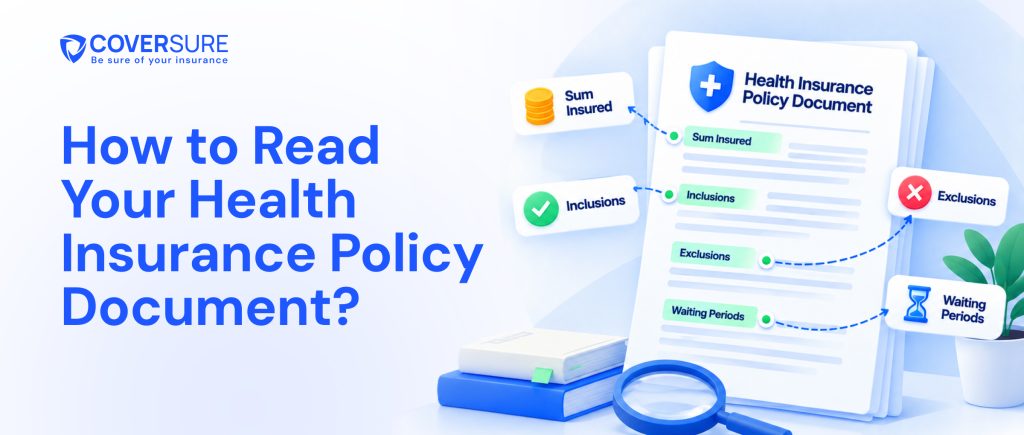
The four parts of a health insurance policy
| Part | What it is | Why it matters |
|---|---|---|
| Policy Schedule | The personalised summary: your details, cover, dates, premium | Errors here can cause claim problems |
| Customer Information Sheet (CIS) | IRDAI-mandated short summary of key features | Quick view of benefits, exclusions and waiting periods |
| Policy Wording | The full terms and conditions | The legal contract; decides claims |
| Endorsements | Changes after issue (members added, SI changed, corrections) | Must be kept with the policy |
Part 1: The Policy Schedule (read this first, line by line)
| Field | What to check |
|---|---|
| Policyholder and insured members | Names, dates of birth, relationships correct |
| Policy number and period | Start and end dates; renewal date |
| Product name and UIN | The IRDAI Unique Identification Number of the product |
| Plan/variant | Matches what you were sold |
| Sum insured (per member or floater) | Matches what you paid for |
| Cumulative bonus | Current bonus amount, if any |
| Add-ons/riders | All selected add-ons are listed |
| Deductible / co-pay | Any voluntary or mandatory cost-sharing |
| Declared pre-existing conditions | All disclosed conditions are listed |
| Specific exclusions or loadings | Any member-specific exclusions or premium loading |
| Premium and tax | Amount, mode, GST treatment |
| Nominee | Correct nominee details |
| Previous policy/portability details | Continuity dates, if ported |
| Heads Up: Found an error? Ask for an endorsement (correction) in writing. Don’t wait for a claim. |
Part 2: The Customer Information Sheet
The CIS is a short, standard-format summary IRDAI requires insurers to give you. It usually covers: product name, what’s covered, what’s excluded, waiting periods, payout basis, cost-sharing, renewal conditions, free look period, and claim and grievance contacts.
Use it as a checklist, then confirm details in the wording.
Part 3: The Policy Wording (where claims are decided)
-
Section A: Definitions
IRDAI has standardised many definitions, so they mean the same across insurers. Key ones: Hospital, Day Care Treatment, Pre-Existing Disease, Inpatient Care, Medical Practitioner, Reasonable and Customary Charges, Co-payment, Deductible, Cumulative Bonus, Grace Period, Moratorium.
-
Section B: Coverage (the benefits)
In-patient hospitalisation, pre- and post-hospitalisation (number of days), day care, domiciliary, AYUSH, ambulance, organ donor, modern treatments, restoration, health check-ups, and any extras. Note every limit attached. See day care explained and domiciliary treatment explained.
-
Section C: Waiting periods
Initial (30 days), pre-existing disease (up to 36 months), specified diseases (commonly 24 months), maternity. See waiting periods explained.
-
Section D: Exclusions
Standard IRDAI exclusions plus any product-specific ones. See exclusions explained.
-
Section E: Limits and cost-sharing
| Clause | Where it hurts | Explainer |
|---|---|---|
| Room rent limit | Proportionate deductions | Room rent limits |
| Co-payment | % of every claim | Co-payment |
| Sub-limits | Caps on specific treatments | Sub-limits |
| Deductibles | Fixed amount you pay first | Deductibles |
-
Section F: General conditions
Disclosure, renewal, portability, migration, cancellation, free look, grace period, moratorium, multiple policies, fraud, and territorial limits.
-
Section G: Claims procedure
Intimation timelines (planned and emergency), cashless and reimbursement processes, document list, and submission deadlines. See how to claim health insurance.
-
Section H: Grievance redressal
Insurer’s grievance officer, IRDAI’s grievance channels, and the Insurance Ombudsman.
Annexures
Lists of non-payable items (consumables), day-care procedures, Ombudsman offices, and sometimes specified-disease lists. See consumables explained.
Case study: reading a policy before a planned surgery
Hypothetical. Meena plans a knee replacement for her mother (63) in 6 months. She opens the policy and answers five questions:
| Question | Where she found it | Answer |
|---|---|---|
| Is joint replacement under a waiting period? | Waiting periods section | 24 months; her mother is in month 30, so it’s done |
| Is there a sub-limit? | Benefits table/annexure | ₹1,50,000 per knee |
| Room rent limit? | Benefits table | 1% of SI (₹5,000/day) with proportionate deduction |
| Co-pay? | Schedule | 20% for insured above 60 |
| Consumables? | Annexure | Not covered |
Her estimate for a ₹3,20,000 surgery (single room at ₹5,000/day, 5 days; consumables ₹20,000):
| Step | Amount |
|---|---|
| Bill | ₹3,20,000 |
| Less consumables | -₹20,000 |
| Admissible before sub-limit | ₹3,00,000 |
| Capped at sub-limit | ₹1,50,000 |
| Less 20% co-pay | -₹30,000 |
| Insurer pays | ₹1,20,000 |
| Family pays | ₹2,00,000 |
Because she read it six months early, Meena can budget, upgrade at renewal, or explore a super top-up, instead of discovering this at discharge.
A 10-minute reading routine
- Schedule: verify every detail (2 minutes).
- CIS: skim the summary (2 minutes).
- Limits table: room rent, co-pay, sub-limits, deductible (2 minutes).
- Waiting periods and exclusions: note anything relevant to your family (3 minutes).
- Claims section: save the helpline and intimation timelines (1 minute).
| Heads Up: Or let us do it in two: upload the policy to Know Your Policy for a plain-English breakdown, and run the Policy Health Check for an expert verdict. |
When to read your policy
- Within the 30-day free look period after buying (free look explained)
- Every renewal, because products and your needs change
- Before a planned procedure
- After any endorsement
Where CoverSure helps
- Store every policy, schedule and endorsement for the family: Insurance Portfolio
- Right-size cover after reading: CoverRisk Calculator
- Upgrade at renewal: Insurance Renewal
- Emergency support: Insurance SOS
- Stuck on a clause? Advisory
| Before you buy, after you buy, at renewal, at claim time: most apps show up for one of these. CoverSure sticks around for all of them, like a friend who actually helps you move house.
Book a call with us. We’ll tell you if it’s a real problem or just legalese. |
FAQs
- What are the main parts of a health insurance policy? Policy Schedule, Customer Information Sheet, Policy Wording (with annexures), and Endorsements.
- What should I check first? The Policy Schedule: names, dates of birth, sum insured, add-ons, and declared conditions.
- What is the Customer Information Sheet? An IRDAI-mandated summary of key features, exclusions, and waiting periods.
- What is a UIN on a health policy? The Unique Identification Number IRDAI assigns to the insurance product.
- What if my policy has an error? Request a correction endorsement in writing from the insurer.
- “Hey Siri, how do I read my health insurance policy?” Start with the schedule, then the customer information sheet, then check limits, waiting periods, exclusions, and the claims section in the policy wording.
Learn to read the fine print (without falling asleep): follow the CoverSure newsletter.