| QUICK GIST |
|---|
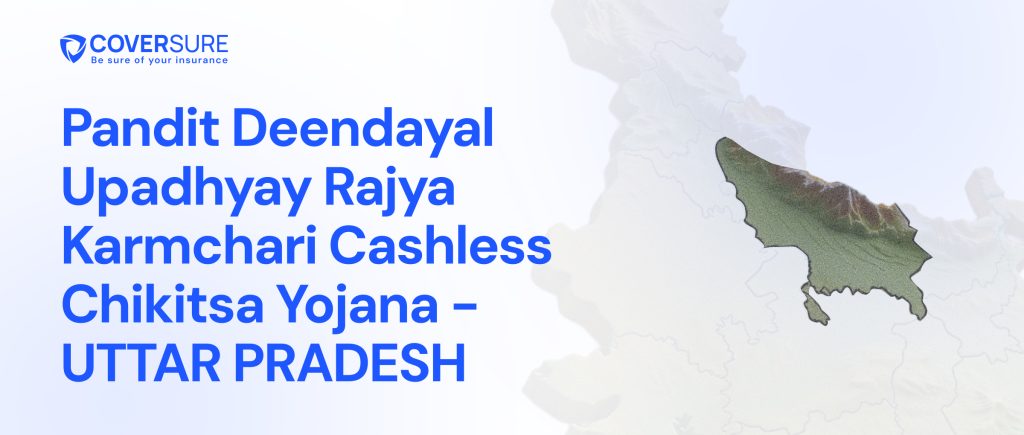
| The Pandit Deendayal Upadhyay Rajya Karmchari Cashless Chikitsa Yojana is Uttar Pradesh’s cashless health scheme for state government employees, pensioners and their dependent family members. It was launched on 21 July 2022. Beneficiaries get a State Health Card that allows cashless treatment at eligible government hospitals, and up to ₹5 lakh per year at empanelled private hospitals. The scheme is run with SACHIS, the agency that manages Ayushman Bharat in UP, so private hospitals in the Ayushman Bharat network are part of it. You apply online at sects.up.gov.in, where your application is approved by your DDO or treasury officer, after which you complete Aadhaar eKYC and download the card. Teachers covered by the state’s separate teachers’ cashless scheme apply there instead. The helpline is 1800 1800 4444. |
The UP State Health Card, Explained: Cashless Care for Government Employees, Pensioners and Their Families
A health scheme that starts with your service book
Most blogs in this series are about schemes for families on ration lists or income limits. Uttar Pradesh’s entry is different. It’s built for the people who run the state: clerks, engineers, police staff and the lakhs of pensioners who once did those jobs.
For years, government employees in many states paid hospital bills first and waited for reimbursement later. UP changed that in July 2022 with a cashless State Health Card. At launch, the state said around 22 lakh serving and retired employees, and about 75 lakh people including families, would benefit.
If you or a parent is a UP government employee or pensioner, this card can save you from arranging cash at the hospital counter. Here’s how it works.
| Retired from the UP government and still filing reimbursement claims in triplicate? There’s an easier way, and we can walk you through it. Book a call with us. No file noting, no “come back on Monday”. |
|---|
What the State Health Card covers
The scheme gives eligible employees, pensioners and dependants a digital State Health Card for cashless hospital treatment.
- Government hospitals and medical colleges: cashless treatment at eligible government facilities.
- Empanelled private hospitals: cashless treatment up to ₹5 lakh per year.
- Ayushman Bharat network: private hospitals registered under Ayushman Bharat are part of the network.
- No upfront payment for covered treatment, and no reimbursement paperwork.
- Fully funded by the Uttar Pradesh government.
| Also have a private family floater? Know Your Policy breaks it down into plain language: what’s covered, what isn’t and what could reduce a claim. Handy for working out where it adds to your State Health Card. |
|---|
Getting your State Health Card
- Go to the official portal at sects.up.gov.in and choose “Apply for State Health Card”.
- Enter employee or pensioner details and save.
- Add dependants, upload their ID proof and photographs, and submit.
- Wait for approval. Your application goes to your Drawing and Disbursing Officer (DDO) or Treasury Officer (TO).
- Complete eKYC. After approval, you’ll get an SMS link to finish Aadhaar OTP verification.
- Download your card from the portal and keep a copy on your phone.
- Show it at admission at a government or empanelled private hospital.
Help is at 1800 1800 4444 or support.sects@sachis.in.
| Ready to apply or check status? Head to the official State Health Card portal for applications, status, edits and the hospital list. Much faster than chasing the department head clerk. |
|---|
| Working for the UP government but your parents live in Bihar or Uttarakhand? The CoverSure State Health Scheme Calculator shows what each state offers, side by side. |
|---|
Small details that make a big difference
The ₹5 lakh private limit is per year. Government hospitals don’t carry the same stated cap, but private hospitals do. A big private-hospital bill can go past it.
Approval runs through your office. Your DDO or Treasury Officer approves your application. If it’s stuck, follow up early, not when someone is unwell.
Dependants must be added properly. Only dependants listed and approved on your card are covered.
Teachers may be in a different scheme. Staff eligible under the state’s teachers’ cashless scheme should apply there instead.
OPD isn’t the focus. The card is meant for hospital treatment, not routine outpatient consultations.
| Have a private policy you’ve renewed since your joining year? A Policy Health Check reviews it across 30+ parameters for ₹99 and benchmarks it against 1,500+ plans. With the State Health Card in hand, you may need a different kind of private cover, not more of the same. |
|---|
| State Health Card, GPF statement, LIC, car policy: government families collect paperwork like medals. Add your state scheme to your CoverSure insurance portfolio and keep every policy on one dashboard. Turn on Family Share so your spouse or kids can find the card instantly. |
|---|
State Health Card vs a private health plan
The State Health Card is a valuable employment benefit. A private plan is something you own personally, whatever happens to your job.
What the State Health Card does well
- Cashless treatment without upfront payment or reimbursement claims.
- Covers pensioners, not just serving staff.
- Fully funded by the state.
- Ayushman Bharat private hospitals are part of the network.
Where a private plan usually adds more
- Higher limits at private hospitals, beyond ₹5 lakh a year.
- Room choice and comfort features, depending on the plan.
- Restoration, cumulative bonus and add-ons.
- Cover for family members who aren’t eligible dependants, such as married children.
- Portability of your choices. A private policy stays with you, while scheme rules are set by government orders.
For UP government families, the State Health Card handles a lot. A private plan or super top-up is mainly about going beyond ₹5 lakh at private hospitals and covering family members the card doesn’t.
Where ₹5 lakh at a private hospital runs short
Meet the Mishras (a hypothetical family; numbers are illustrative). The father is a retired UP government engineer in Lucknow.
| Event in the year (hypothetical) | Hospital type | Covered by the card? |
|---|---|---|
| Father’s bypass at an empanelled private hospital, ₹4.2 lakh | Private | Yes, within ₹5 lakh |
| Mother’s knee replacement at the same hospital, ₹2.8 lakh | Private | Only ₹80,000 left; ₹2 lakh out of pocket |
| Daughter-in-law’s surgery (not a listed dependant) | Private | No |
The lesson: the card is strong, but private-hospital bills add up quickly in a year with two big surgeries.
| Underinsured, overinsured or just right? The CoverRisk Calculator weighs your income, life stage, dependants and liabilities and tells you where you stand. Free and quick. No file movement required. |
|---|
Who is eligible for the State Health Card?
- Serving Uttar Pradesh state government employees
- Uttar Pradesh state government pensioners
- Their eligible dependent family members
Teachers and education staff eligible under the state’s separate teachers’ cashless scheme should apply under that scheme.
Keep ready: employee or pensioner details, your registered mobile number, Aadhaar, and ID proof and photos of each dependant.
Not a government employee? This card isn’t your route. Eligible UP families are generally covered through Ayushman Bharat PM-JAY and the state’s own Jan Arogya scheme instead.
UP State Health Card at a glance
| Detail | Pandit Deendayal Upadhyay Rajya Karmchari Cashless Chikitsa Yojana (Uttar Pradesh) |
|---|---|
| Launched | 21 July 2022 |
| Run by | Government of Uttar Pradesh, with SACHIS (State Agency for Comprehensive Health and Integrated Services) |
| Who qualifies | State government employees, pensioners and eligible dependants |
| Government hospitals | Cashless at eligible government hospitals and medical colleges |
| Private hospitals | Cashless up to ₹5 lakh per year at empanelled private hospitals |
| Card | Digital State Health Card, after DDO/TO approval and eKYC |
| Cost to you | None; state-funded |
| Main limitations | ₹5 lakh private-hospital limit, approval through your office, dependants must be listed, hospital focus |
| Helpline | 1800 1800 4444 |
| Official website | sects.up.gov.in |
| Got five minutes between files? The State Health Card, explained in a quick LinkedIn carousel. Swipe through it on CoverSure’s LinkedIn and share it with every colleague who’s still saving hospital receipts in a plastic folder. |
|---|
Quick answers (FAQs)
- What is the UP State Health Card? A card under the Pandit Deendayal Upadhyay Rajya Karmchari Cashless Chikitsa Yojana that gives UP government employees, pensioners and dependants cashless hospital treatment.
- Who is eligible? Serving state government employees, pensioners and their eligible dependants.
- What is the private hospital limit? Up to ₹5 lakh per year at empanelled private hospitals.
- Is treatment at government hospitals covered? Yes, cashless at eligible government hospitals.
- How do I apply? Online at sects.up.gov.in, followed by DDO or TO approval and Aadhaar eKYC.
- Can teachers apply? Teachers eligible under the state’s teachers’ cashless scheme should apply there instead.
- Do pensioners get cashless treatment? Yes. Pensioners and their dependants are covered.
- “Hey Google, what’s the UP State Health Card helpline?” Call 1800 1800 4444.
| Your State Health Card covers the hospital. CoverSure covers the rest of your insurance life. Download the CoverSure app to track every policy, get renewal reminders and set up SOS for one-tap alerts. |
|---|
Next up: Nagaland. Subscribe to the CoverSure newsletter and get it before the next staff-room discussion.