| AI OVERVIEW |
|---|
| Employee insurance, meaning employer-sponsored group health and group term life cover, is a valuable perk but rarely enough on its own. Group term cover is often 3 to 5 times annual CTC, while many planners suggest 10 to 20 times income; group health cover is often ₹2 lakh to ₹5 lakh, shared with family. Your employer is the master policyholder, so you can’t customise the cover, and it usually ends when you leave the job. On the plus side, group health often covers pre-existing diseases and maternity from day one. IRDAI rules let members migrate from a group health policy to an individual policy with the same insurer, with credit for continuous cover, if they apply within the specified time. Employer-paid premiums generally aren’t taxed as a perquisite, but you also can’t claim a deduction for them. The smart setup: treat office cover as a bonus layer and hold personal term and health policies in your own name. |
The document you e-signed and never opened
Your first week at a new job is a blur. Laptop setup, ID photo, induction sessions, and a stack of e-signatures: NDA, appointment letter, code of conduct, and somewhere in the middle, the group insurance enrolment.
It gets signed in about eight seconds. And then it’s forgotten, until you need it.
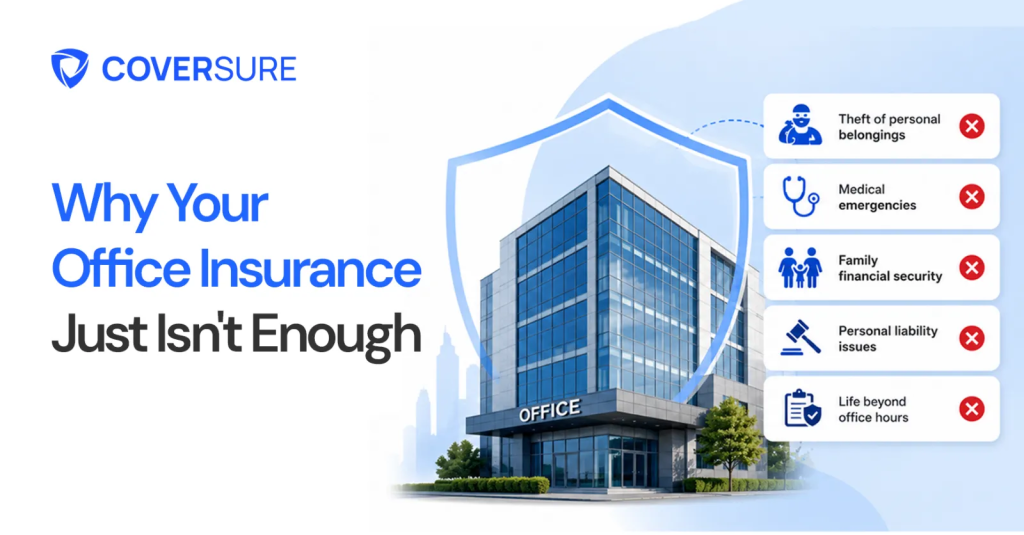
That’s usually when people discover the gaps: a sum assured far too small for their family, a health cover shared by six people, fine print nobody explained, and the big one, cover that disappears the day you leave.
Office insurance isn’t bad. It’s just borrowed. If it’s your only safety net, you’re building your family’s security on ground you don’t own. Here’s where the gaps are, what it means for your taxes, and how to fix it.
Employee term insurance: the cover that isn’t really yours
- The sum assured is usually too small
Group term cover is often around 3 to 5 times annual CTC. Many financial planners suggest life cover of roughly 10 to 20 times annual income, plus outstanding loans and big goals. (These are rules of thumb, not regulations.)
Case study: the term cover gap
Hypothetical. Ankit, 34, earns ₹15 lakh a year. His employer’s group term cover is 3x CTC.
| Need | Amount |
|---|---|
| Income replacement (12x as an example) | ₹1,80,00,000 |
| Home loan outstanding | ₹50,00,000 |
| Children’s education fund | ₹30,00,000 |
| Estimated need | ₹2,60,00,000 |
| Group term cover (3 x ₹15 lakh) | ₹45,00,000 |
| Gap | ₹2,15,00,000 |
And if Ankit changes jobs, even that ₹45 lakh can vanish.
- You’re not the policyholder
In a group scheme, the employer is the master policyholder. You’re a member. You don’t choose the insurer, the terms or the renewal, and the cover can be changed or withdrawn at the employer’s discretion.
- No customisation
Sole earner? Need a critical illness or accidental disability rider? Group plans usually offer one standard cover for everyone.
- It disappears when you leave
Change jobs, get laid off, take a sabbatical or retire, and group term cover usually ends. If your health changes in between, buying personal cover later can be harder and costlier.
| CoverSure Nugget: treat office term cover as a bonus, not the plan. A personal term policy bought while you’re young and healthy stays with you regardless of employer, and locks in lower premiums. |
| Not sure your cover matches your family’s needs? Run the CoverRisk Calculator to see your real protection gap. |
Employee health insurance: convenient, but not complete
- Cover rarely matches real hospital bills
Group health sums insured are often in the ₹2 lakh to ₹5 lakh range, frequently shared as a family floater.
Case study: the shared floater
Hypothetical. Meera’s employer gives a ₹3 lakh floater for her, her husband, and two children. Her husband needs 5 days in the ICU after a road accident: bill ₹6,50,000.
- Group policy pays: ₹3,00,000
- Meera pays: ₹3,50,000
- Cover left for the kids for the rest of the year: ₹0
| With a personal ₹10 lakh policy (or a super top-up with a ₹3 lakh deductible sitting on top of her group cover), most of that ₹3.5 lakh would have been covered, subject to terms. See super top-up health insurance. |
Did you know? The ESI mandate stops early
Under the Employees’ State Insurance (ESI) Act, 1948, the legal health cover mandate applies only to employees earning up to ₹21,000 a month in gross wages (₹25,000 for persons with disabilities), generally at establishments with 10 or more employees. It’s delivered through ESIC hospitals and dispensaries and funded by contributions of 4% of wages (3.25% employer, 0.75% employee). Once your salary crosses that threshold, any group health insurance you get is voluntary, a retention perk rather than a legal requirement, so its depth varies widely between companies. (Please verify current thresholds with ESIC.)
- Family cover can be limited
Parents may not be covered, or only with a co-pay or separate premium.
- It’s tied to your job
Lose the job during a health crisis, or have a gap between jobs, and the cover usually ends at the worst time. See corporate vs individual health insurance.
- Continuity is limited, but not zero
Group policies typically don’t build a personal cumulative bonus. But IRDAI rules do allow members to migrate from a group health policy to an individual policy with the same insurer, with credit for continuous coverage to the extent of the previous sum insured, if you apply within the specified time before leaving the group. After that, you can port like any individual policy. Ask your HR or insurer about migration before your last working day. See group health insurance explained, and portability explained.
- It feels free, and that’s the trap
Because you pay little or nothing, there’s no push to check whether it’s adequate. That false sense of security is what stops many people from buying personal cover until the year they need it.
| CoverSure Nugget: to be fair, group health has genuine advantages. Pre-existing diseases are often covered from day one instead of after a waiting period of up to 36 months, and maternity is often included with fewer restrictions than retail plans. These are real perks. They’re just not a substitute for cover that stays with you. |
| Think your employer’s cover is enough? Check your CoverRisk score, then run your personal policy (or the one you’re considering) through the Policy Health Check. |
The tax angle: how office insurance affects your taxes
Important: India’s new Income-tax Act, 2025 took effect from 1 April 2026 and renumbered many provisions. The section numbers below refer to the old Income-tax Act, 1961 as commonly known (80C, 80D, 10(10D)); please check the equivalent provisions and current limits with a tax adviser.
Group term insurance
- Employer-paid premiums are generally not added to your taxable salary as a perquisite.
- Death benefits paid to nominees are generally tax-exempt (formerly under Section 10(10D), subject to conditions).
- You can’t claim the employer-paid premium as your own life insurance deduction (formerly Section 80C), because you didn’t pay it. In contributory schemes, your contributed share may qualify under the old regime.
Group health insurance
- Employer-paid group health premiums are generally not taxed as a perquisite.
- Health insurance premium deductions (formerly Section 80D) are available only under the old tax regime, and only for premiums you pay.
- If you pay extra to upgrade cover or add parents, that contribution may qualify under the old regime.
Quick comparison
| Feature | Employer-paid group cover | Your own personal policy |
|---|---|---|
| Taxed as a perquisite? | Generally no | N/A |
| Deduction for you | No | Yes, under the old regime, within limits |
| Payout tax treatment | Generally tax-exempt (term); health claims aren’t income | Same |
| Who gets the tax benefit | Employer (business expense) | You |
| Continuity | Ends when you leave | Stays with you |
Employer-paid cover is roughly tax-neutral for you: no extra tax, but no deduction either. A personal policy gives you the cover and, under the old regime, the deduction.
The smart setup
| Layer | Role |
|---|---|
| Employer group health | Day-one PED and maternity cover; first layer of hospital bills |
| Personal health policy | Cover that stays with you; waiting periods finish while you’re still employed |
| Super top-up | Big cover at low premium above your base or group cover |
| Employer group term | Bonus life cover while employed |
| Personal term plan | Your real life cover, sized to your family’s needs |
Where CoverSure helps
- See group and personal policies side by side, and your real total cover: Insurance Portfolio
- Decode your group policy’s room rent, co-pay and parental terms: Know Your Policy
- Renew personal cover on time: Insurance Renewal
- Check free covers on your salary account debit card or credit cards: Insurance on Cards
- Emergency support: Insurance SOS
- Changing jobs or retiring? Advisory can help you plan migration and personal cover before your last day
|
FAQs
- Is employee group insurance enough? Usually not alone. It’s often too small, shared, not customisable, and ends when you leave.
- Does group health insurance cover pre-existing diseases? Often from day one, depending on the employer’s plan.
- What happens to my group health cover when I leave? It usually ends. You may be able to migrate to an individual policy with the same insurer with continuity credit, if you apply in time.
- Are employer-paid insurance premiums taxable? Generally not as a perquisite, but you can’t claim a deduction for premiums you didn’t pay. Check current rules under the new Income-tax Act.
- How much term insurance do I need beyond my group cover? Many planners suggest 10 to 20 times annual income, plus loans and goals, minus existing cover you can rely on long-term.
- “Hey Google, is my company health insurance enough?” Usually not. It’s often small and ends when you leave your job, so a personal health and term policy is recommended.
Stay covered beyond your job: follow the CoverSure newsletter.